
UW PHI Model of Health
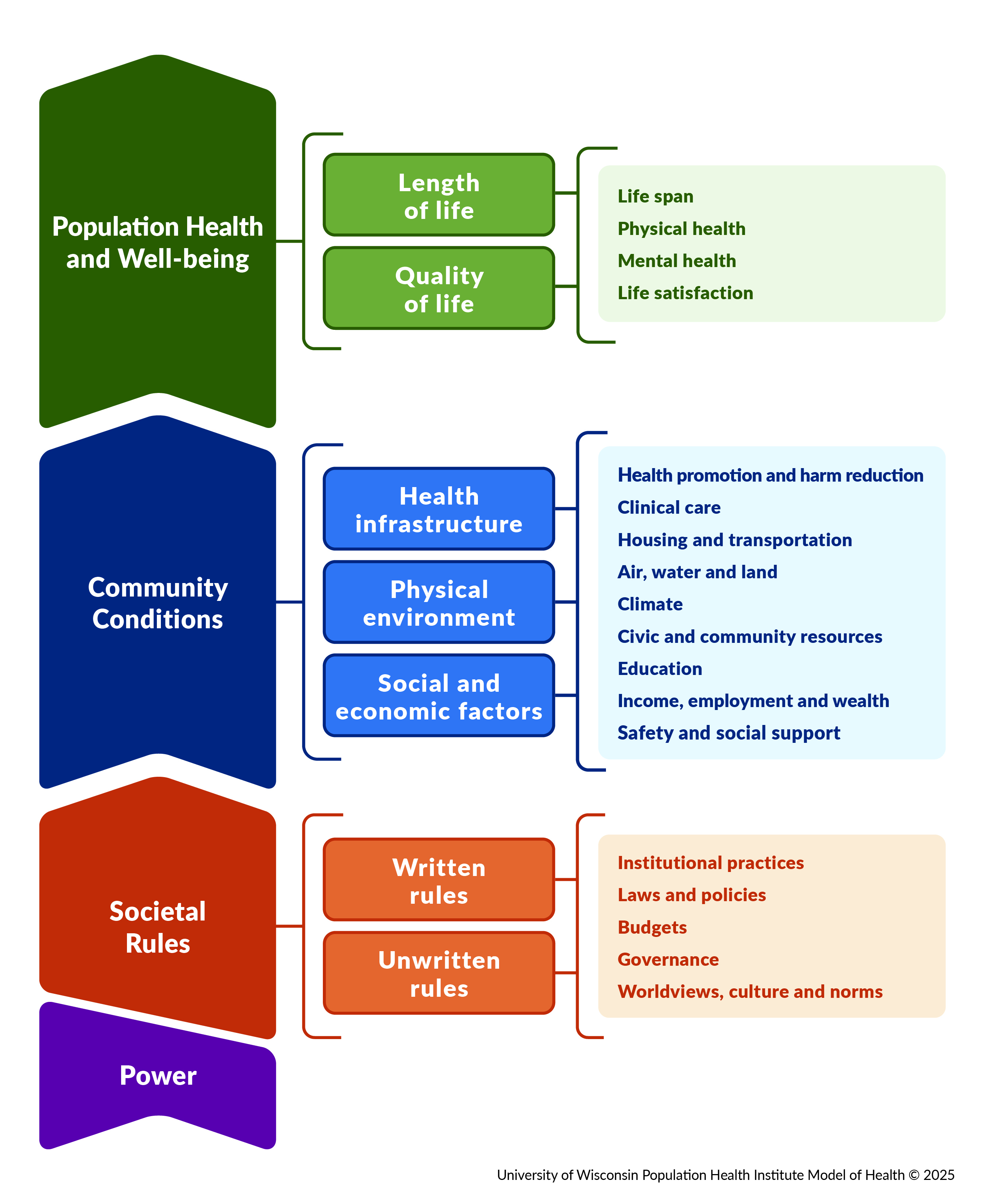 People and communities can structure society so that everyone has an opportunity to thrive.
The University of Wisconsin Population Health Institute (UW PHI) Model of Health shows how the community conditions - where we live, learn, work and play - affect our collective health and well-being. These conditions result from the ways in which societal rules, both written and unwritten, are used to determine which communities have access to the resources needed to thrive. People who hold more power shape the rules and how they are applied based on their values and beliefs.
The What Works for Health database is organized into health topics that reflect the Community Conditions categories. Each strategy also indicates if it aligns with one or more societal rules.
Learn more about each component of the UW PHI model of health.
Population Health and Well-being
Population health and well-being is something we create as a society, not something an individual can attain in a clinic or be responsible for alone. Health is more than being free from disease and pain; health is the ability to thrive. Well-being covers both quality of life and the ability of people and communities to contribute to the world. Population health involves optimal physical, mental, spiritual and social well-being.
Community Conditions
Community conditions include the social and economic factors, physical environment and health infrastructure in which people are born, live, learn, work, play, worship and age. Community conditions are also referred to as the social determinants of health.
Societal Rules
Societal rules are the written and unwritten rules and how they are applied to shape community conditions. Written rules may be formalized and documented in laws, policies, regulations and budgets. Unwritten rules are made up of worldviews, culture and norms. These can include customs or expectations that guide acceptable thought and behavior without being documented in writing. Institutional practices and systems of governance – such as an organization’s approach to salary parity – may be written or unwritten. Societal rules, and how they are created and maintained by those with power, are referred to as the structural determinants of health.
Power
Power is the ability to achieve a purpose and to effect change. People can build community power when they organize and act together to set agendas, shift public discourse, influence who makes decisions and cultivate relationships with decision makers. Societal rules and how they are created and maintained by those with power are referred to as the structural determinants of health.