
Our Methods
What Works for Health (WWFH) is an evidence clearinghouse based on a model of population health that emphasizes factors that can make communities healthier places to live. Support for County Health Rankings & Roadmaps' What Works for Health was provided by the Robert Wood Johnson Foundation. The views expressed here do not necessarily reflect the views of the Foundation. Analysts review research to rate strategies’ effectiveness in improving health and advancing equity. Strategies include policies, programs, and systems and environmental changes. This image outlines the process that analysts follow.
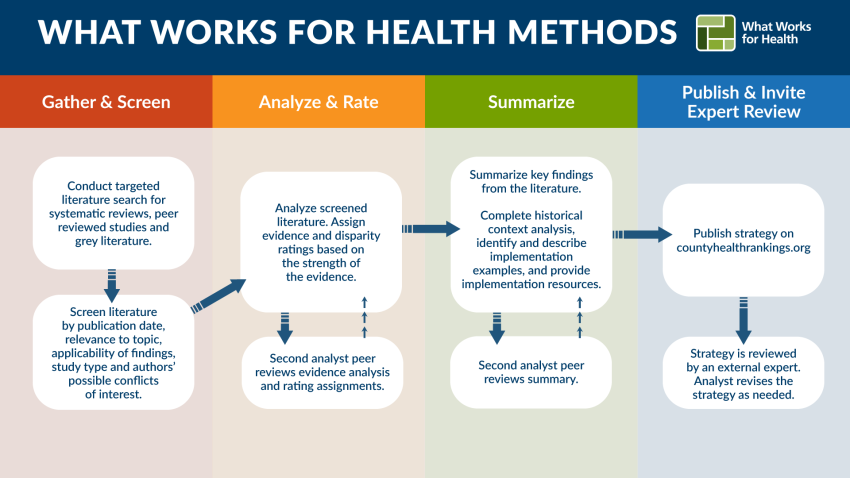
What Works for Health methods process
Gather and screen evidence -+
Literature Search
Analysts begin with a broad literature search to define what will be included in each strategy and identify appropriate search terms. Next, analysts conduct a focused search, prioritizing systematic reviews and peer-reviewed articles. Finally, analysts search grey literature and other evidence clearinghouses that assess policy and program effectiveness.
Literature Screen
Analysts screen articles by date, relevance, applicability of findings, study type and authors’ possible conflicts of interest. They retain the most relevant, recent, rigorous reviews and articles.
Analyze and rate evidence -+
Analysts record sources’ key findings and quality. This includes consideration for study design, quality, and strength of finding(s). Analysts then assess the strength of the body of evidence, which includes the number and duration of studies and the consistency of their findings. Analysts then assign initial evidence and disparity ratings. A second analyst reviews a summary of the evidence and assigns an independent rating. Final ratings are assigned based on the assessment of both analysts.
Learn about our rating guidelines.
Evidence Rating
Analysts assign strategies’ evidence ratings based on quality, quantity and findings of relevant research. Studies with designs that demonstrate causality are given the most weight. Ratings are based on the likelihood of achieving specific outcomes, labeled expected benefits. Outcomes with weaker or less evidence are labeled potential benefits.
Disparity Rating
Analysts assign each strategy a disparity rating based on research about how a strategy may affect disparities (e.g., racial/ethnic, socioeconomic, or geographic disparities) for health and the social determinants of health. Analysts also consider each strategy’s characteristics, such as population, delivery method and cultural considerations. A strategy’s impact on disparities may change depending on how it is implemented (e.g., tailoring a strategy toward a specific population).
Some strategies also feature an expanded disparity rating to indicate potential impact on disparities and describe the strength of the evidence supporting the rating. The expanded ratings are part of WWFH’s equity analysis.
Summarize and review -+
Analysts draft a summary of the key findings that support the evidence rating and clarify to which subgroups and outcomes it applies. Strategies with an expanded disparity rating also feature a historical context section and equity considerations. Equity considerations can help users gauge whether a strategy fits their community’s needs and can guide conversations during implementation.
Implementation Examples and Resources
Analysts include examples of strategies in action and tools to support implementation. Examples come from the literature review and from additional focused searches.
Expert Review
External experts are invited to review each strategy and identify ratings they deem incorrect or inappropriate based on their knowledge of literature in the field.